Online Inkjet Systems for Conveyor-Based Production
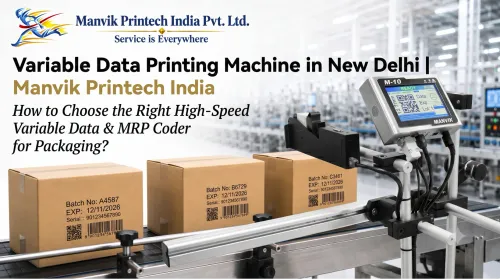
Your production line is moving, the cartons are passing one by one, and each pack needs the right date, batch number or barcode. An online inkjet system prints this variable information directly onto products as they travel along a conveyor—so operators do not have to stop the line and stamp every item by hand.
The best setup is more than a printer attached to a conveyor. It combines a suitable printhead, reliable product detection, stable positioning and correctly timed messages. Manvik Printech India lists online TIJ options and conveyor-related coding equipment among its products.
What is an online inkjet system?
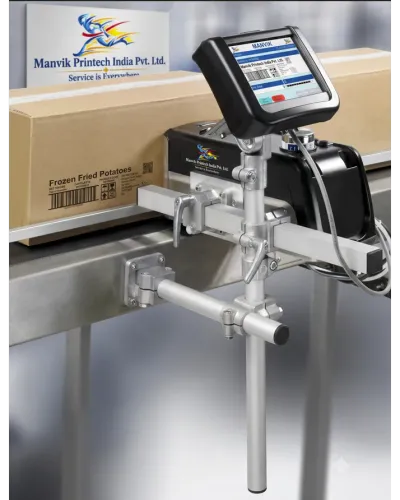
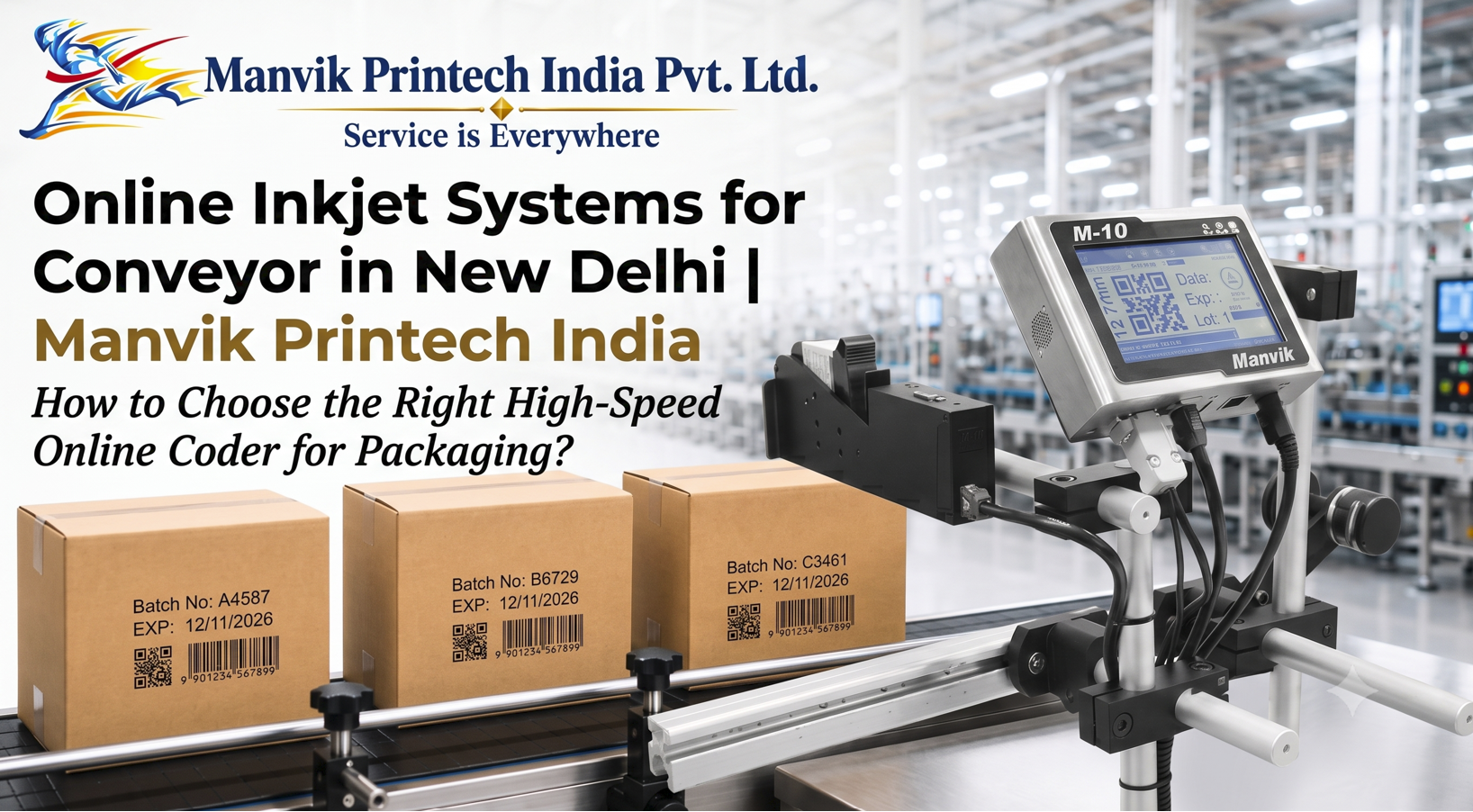
An online inkjet system is mounted beside or above a production line. As each item reaches the print point, a sensor detects it and triggers the printer to apply the programmed message.
Depending on the printer and application, that message can include:
- Batch or lot numbers.
- Manufacturing and expiry dates.
- MRP or product details.
- Barcodes and QR codes.
- Serial numbers.
- Logos or short product messages.
Online systems commonly use Thermal Inkjet (TIJ) or Continuous Inkjet (CIJ) technology. The appropriate option depends on the product, surface, print requirements and operating conditions.
How does conveyor-based printing work?
A typical installation follows a straightforward sequence:
- Products move along the conveyor.
- A sensor detects each product.
- The printer receives the trigger.
- The printhead applies the selected message.
- The coded product continues to packing, inspection or dispatch.
An encoder can provide information about conveyor speed, while guides help maintain product position. These components are useful when product movement or spacing varies; integration requirements depend on the line and printer configuration.
What can an online inkjet printer mark?
Online inkjet systems may print on cartons, labels, pouches, bottles, containers and selected industrial products. Materials include paperboard, corrugated packaging, plastic and other surfaces, but the correct printer and ink depend on the specific substrate.[manvikprintechindia]
Common applications include:
- Food and beverage packaging.
- Pharmaceutical cartons and labels.
- FMCG and personal-care products.
- Pouches, sachets and flexible packaging.
- Bottles, jars and containers.
- Corrugated boxes and shipping cases.
- Industrial parts and components.
If the surface is glossy, coated, dusty, wet or oily, test it before choosing the ink or printer.
Why use online inkjet instead of manual coding?
More consistent placement
A sensor triggers the print when each product reaches the coding point. With well-positioned guides and a stable conveyor, this can make placement more repeatable than hand stamping.
Less manual handling
Operators do not need to pick up and code each pack individually, which can help reduce repetitive manual work.
Easier message changes
Digital message settings can make it more practical to change batch details, dates or product information between runs than replacing a fixed stamp.
Fit with production flow
Inline printing can be integrated with an existing conveyor or packaging process. The required sensors, mounting and control signals should be planned for the particular line. [manvikprintechindia]
TIJ or CIJ for your conveyor?
ConsiderationTIJCIJCommon useHigh-resolution text and codes on cartons, labels and suitable packagingContinuous coding on many products moving along production linesInk systemCartridge-basedInk and make-up fluid systemUseful to assessPrint resolution, cartridge compatibility and surfaceLine speed, ink choice and product surfaceInstallationCan be mounted online or used in handheld systemsCommonly integrated into continuous production linesKey decisionIs the required code clear on this substrate at line speed?Can it maintain the needed mark on the moving product?
This is a starting point, not a substitute for an application test. Check the actual message, packaging and line speed before selecting a printer.
What affects print quality on a conveyor?
Product spacing
Products placed too close together can complicate triggering and message placement. Establish the minimum gap and confirm that the sensor can distinguish each item.
Conveyor speed
The printer must handle the required speed and message length. A longer code or larger print area may affect the achievable rate.
Product position
Shifting, rotating or unevenly guided products can result in codes printed in the wrong place. Guides and a stable mounting arrangement help control the print position.
Sensor timing
A sensor that triggers too early or too late can shift the mark. Test its location and timing under normal operating conditions.
Surface and ink compatibility
A code may smear, fade or fail to adhere if the ink is not suited to the packaging. Test after drying and after the product has been handled or packed.
A practical pre-purchase checklist
Before asking for a quotation, prepare:
- Product or packaging sample.
- Material and surface finish.
- Required message and print size.
- Conveyor speed and product spacing.
- Desired print position.
- Whether products stop or move continuously.
- Barcode or QR-code scanning requirements.
- Ink colour and drying conditions.
- Available space for printhead and sensor mounting.
- Any connection needed to a PLC, scanner, computer or production system.
This information helps the supplier assess the printer, sensor and installation requirements together, rather than quoting for a printer without considering the line.
Test before installation
A sample test should use the actual product and message. Check:
- Print clarity and contrast.
- Position consistency across multiple products.
- Barcode or QR-code readability.
- Drying and smudge resistance.
- Performance at the intended conveyor speed.
- Results on packaging after normal handling.
- Trigger behaviour when product spacing varies.
If the line runs several products or package sizes, test each important format and confirm how operators will select the correct message.
Online inkjet systems from Manvik Printech India
Manvik Printech India lists TIJ printers that can be used in handheld and online configurations, as well as conveyor-related coding products. Its published product information also describes conveyor integration using sensors and product guides, with suitability depending on the application.[manvikprintechindia][manvikprintechindia][manvikprintechindia]
When enquiring, share the packaging material, print content, line speed, product dimensions and a photograph or sample. Those details can help determine whether an online TIJ system is suitable or whether another coding technology should be considered.
Why choose Manvik Printech India?
- A range of coding and marking equipment, including TIJ and conveyor-related systems.[manvikprintechindia][manvikprintechindia]
- Options to discuss batch dates, MRP, barcodes, QR codes and other variable data.[manvikprintechindia]
- Application discussion that can take conveyor speed, product spacing and print position into account.
- A Delhi-based contact point for product and quotation enquiries.[manvikprintechindia]
Address and contact details
Manvik Printech India Pvt. Ltd.
First Floor, School Block, S-531-A, Shakarpur Khas Part 2, Block S 2, Upadhyay Block, Laxmi Nagar, Delhi, 110092, India
Phone: +91 99069 05312
Additional phone: +91 88827 65261
Email: ravi.sharma@manviktechnologies.in
Website: manvikprintechindia.com
Confirm current contact information, product availability and installation support with Manvik Printech India before publishing.
FAQs
Can an online inkjet printer work with an existing conveyor?
It may be possible, but the printer needs suitable mounting, product detection and trigger timing. Check the conveyor layout and available signals before installation.[inkjetwell][manvikprintechindia]
Does the conveyor have to stop for printing?
Not necessarily. Online systems can print as products move, provided the printer and setup suit the line speed and application.
Can an online system print QR codes?
Some systems can print QR codes. Confirm the required size and resolution, then test with the scanner used in your process.
What if products are not evenly spaced?
Sensor choice and trigger setup matter. Product guides or changes to spacing may also be needed, depending on the conveyor and printer.
What information should I share for a recommendation?
Provide the substrate, print content, product dimensions, conveyor speed, spacing, print location and whether codes need to scan. A physical sample is useful for testing.
Keywords